
After the holiday season, new items land in the household budget: the school year, energy bills and the start of the heating season. September is another test of how resilient households really are. According to a survey for EOS KSI Slovensko, 21.5% of respondents had no financial buffer before the summer, and another 18.4% had €500 or less available.
That means four in ten Slovaks enter autumn with no buffer, or with a very thin one – and further data shows that a significant share of them also have very little room to rebuild it quickly.
At the other end of the scale are the 34.7% who have more than €1,500 set aside, which points to wide differences in household resilience.
Rebuilding the buffer: 41% can set aside €50 a month at most
A household's financial resilience is not only tested by a major loss of income. A broken appliance, an unplanned car repair, a medical expense or several larger payments falling due in the same month can test it just as well.
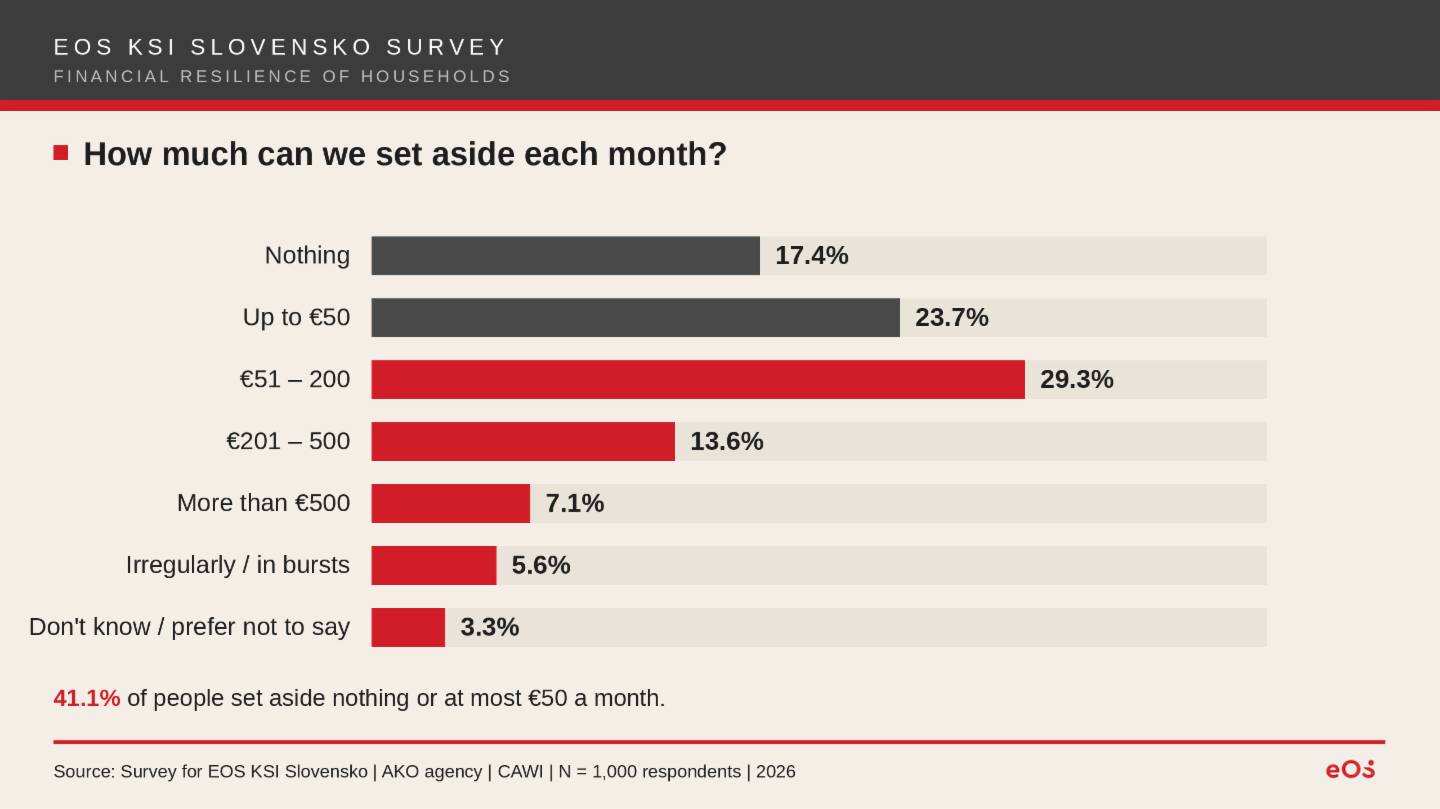
A significant share of people have both a small buffer and limited scope to top it up. 17.4% of respondents cannot set aside anything at all in a month, and a further 23.7% can save €50 at most – together 41.1% of those surveyed. For many households, rebuilding a buffer after an unexpected expense can therefore be very slow, or there may be no room for it in the monthly budget at all.
The largest group are those who can set aside €51 to €200 a month: 29.3%. A further 13.6% save €201 to €500 a month, and only 7.1% of this representative sample of Slovaks save more than €500.
“Financial problems often do not start with a large debt. They start with smaller gaps in the budget, and they become a real problem when those gaps keep coming back. Even a household that can absorb one unexpected expense may struggle with a second or third one in quick succession. That is why it helps to see a buffer not as a sum you put aside once, but as part of everyday financial planning,” says Peter Dvornák, Managing Director of EOS KSI Slovensko.
What happens when a €300 expense arrives? For almost a quarter of respondents, it is a problem
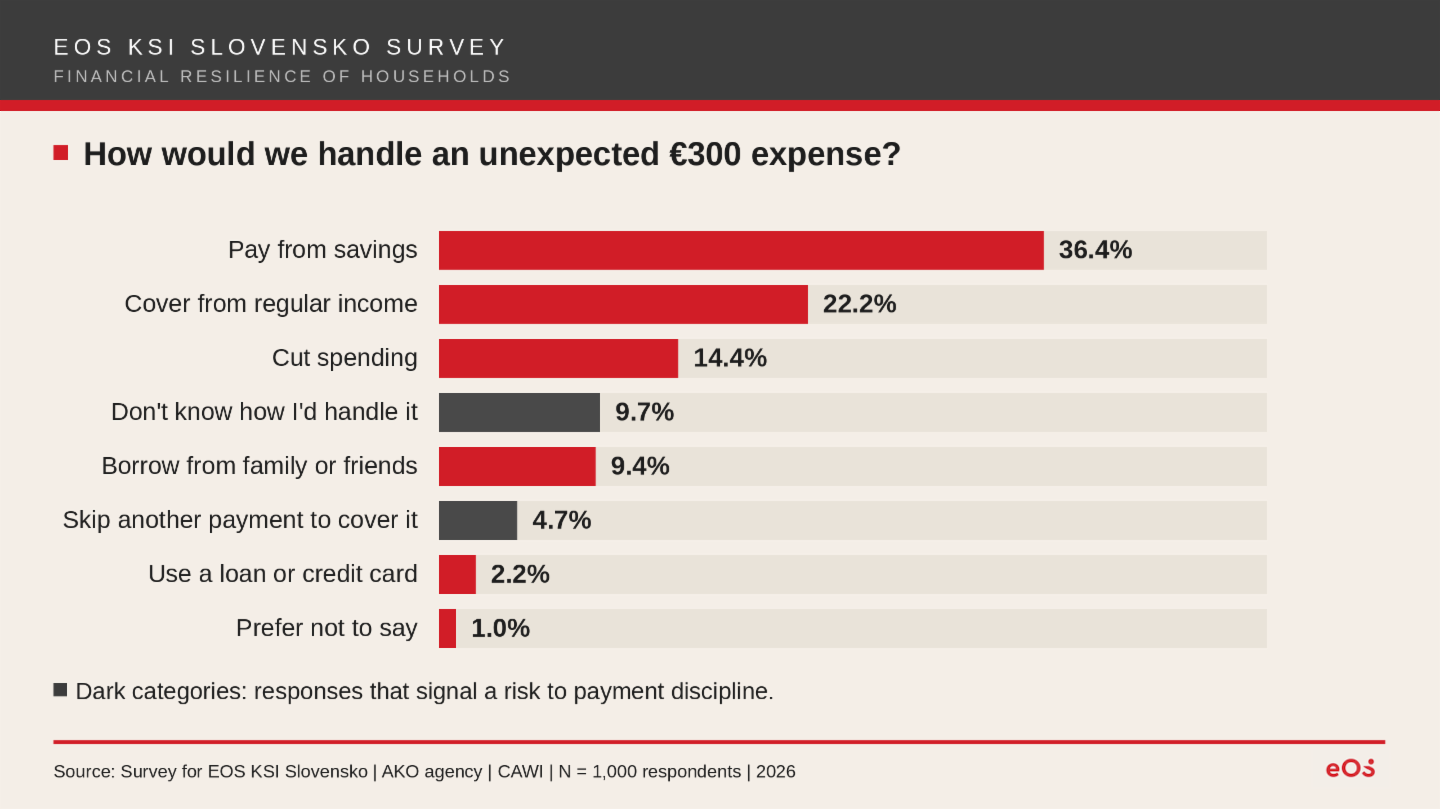
The survey also asked about a specific situation: how respondents would deal with an unexpected expense of €300.
More than a third, 36.4%, would pay it from savings. Another 22.2% would cover it from their regular income, and 14.4% would cut their current spending. Almost one in ten Slovaks, however, would have to borrow from family or friends – 9.4% of respondents chose this option.
Two figures are a warning sign when it comes to payment behavior:
- 9.7% of respondents do not know how they would handle such a situation, and it would be a problem for them.
- 4.7% would pay the unexpected expense, but at the cost of another payment they would leave unpaid.
In the experience of the debt collection company EOS KSI Slovensko, moving a gap in the budget from one payment to the next is exactly how a chain of financial problems tends to begin.
The results also show how differently households are placed when an unexpected expense arrives. 42.9% of respondents are highly confident they could handle a €300 expense. 18.7% have very little confidence in their ability to cover it, and 9.5% have none at all.
At first glance, €300 may look manageable. In a household budget, it can be an event that simply cannot be postponed.
“The data shows that being able to handle an unexpected expense says nothing yet about how a household will cover it. Some people reach for savings, some manage it out of regular income, and others already have to cut other spending or look for help elsewhere. It is the way people solve it that tells us most about a household's real financial resilience,” explains Václav Hřích, Director of the research agency AKO.
After the summer, it pays to look at the budget again
September can therefore be a good moment to review family finances. It is not only about how much a household spent over the summer, but above all about how much is left for regular payments and what buffer is ready for situations that cannot be planned.
“Unexpected events are part of life in every household. A buffer cannot stop them from happening, but it can substantially change how a household copes with them. Even a small amount set aside regularly creates room for one unplanned expense not to trigger further financial problems,” concludes Peter Čanda, Specialist at EOS KSI Slovensko.
Methodology
The survey for EOS KSI Slovensko was conducted by the AKO agency using the CAWI method on a representative sample of N = 1,000 respondents.
Phone: +421 907 821016
Explore more from EOS