
- 46 percent of European consumers confirm improved communication with their bank through AI
- 29 percent would even prefer talking to AI rather than a human about sensitive financial matters
- 61 percent would like to receive proactive AI warnings when their account is at risk of being overdrawn
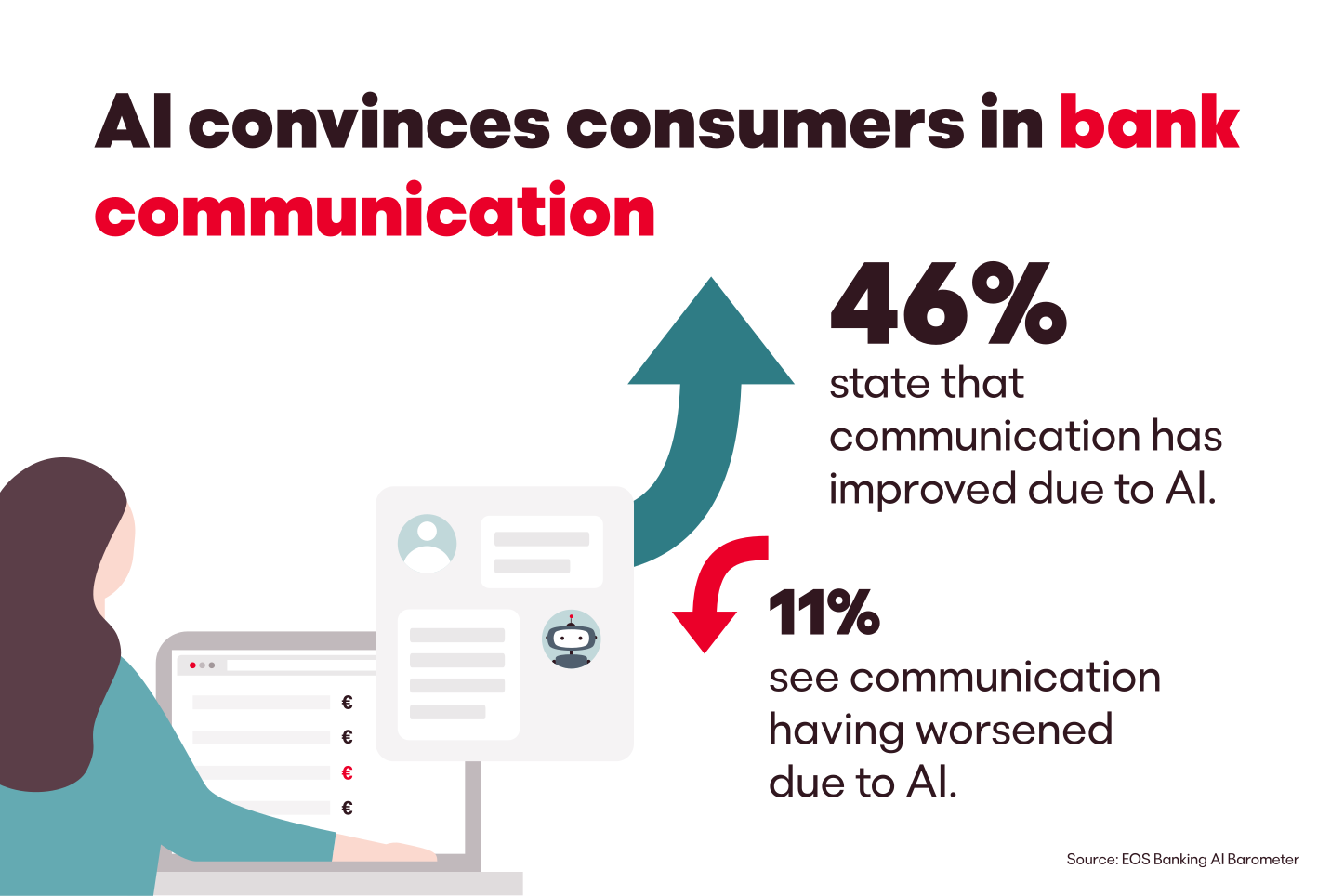
AI in a bank’s customer service centre? Until not so long ago, this was unimaginable for most consumers – but that is changing. Some 46 percent of European consumers say that communication with their bank has improved through the use of AI. Only 11 percent perceive a deterioration. These are the results of the latest EOS Banking AI Barometer study.
Human or AI? Who would consumers prefer to talk to about sensitive financial matters?
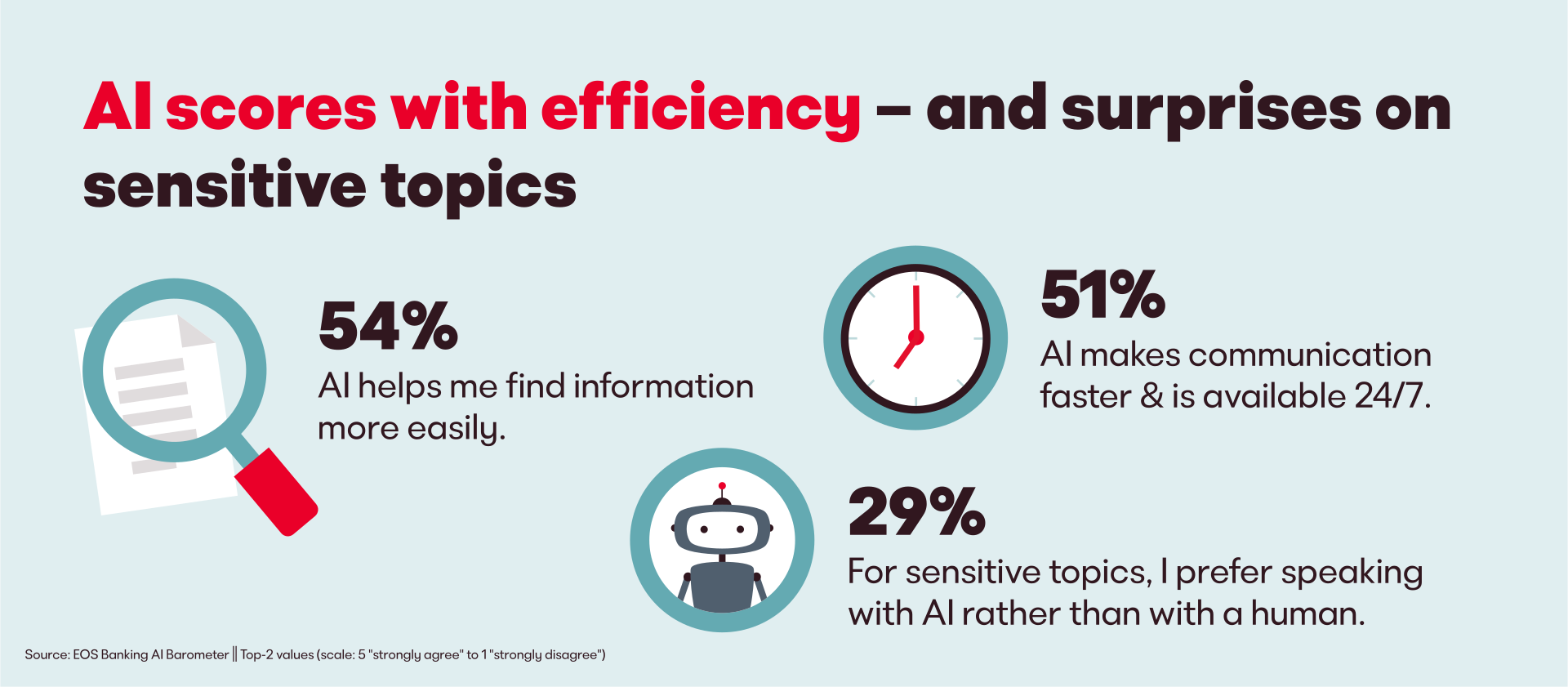
What is remarkable is the respondents’ attitude towards sensitive financial matters: On the one hand, 60 per cent miss the human element in communication with AI. On the other hand, almost one in three respondents (29 percent) would even prefer talking to AI rather than a human about sensitive banking matters. Among 18- to 34-year-olds, the figure is even higher (38 percent). “The best banks use AI as a tool for better service, not as a replacement for relationships,” comments Marwin Ramcke, CEO of the EOS Group, on the study results.
What are the greatest benefits of AI at banks from a customer perspective?
How significantly AI changes banking also depends on the specific benefits the technology provides in everyday life. From the consumers’ perspective, AI’s strengths lie primarily in simplifying processes. More than half of respondents (54 percent) value AI as a useful tool when searching for information. Some 51 percent praise faster communication and round-the-clock availability. However, in the areas of comprehension, precision and problem-solving, approval ratings for AI’s capabilities are only between 35 and 36 percent.
What additional AI services would consumers like?
The outlook is likely to be most revealing for the banking sector: the study not only shows where AI is accepted today but also where consumers would clearly like more AI support.

Our study shows a clear direction in the use of AI services: customers want AI that is not only reactive but also proactive.
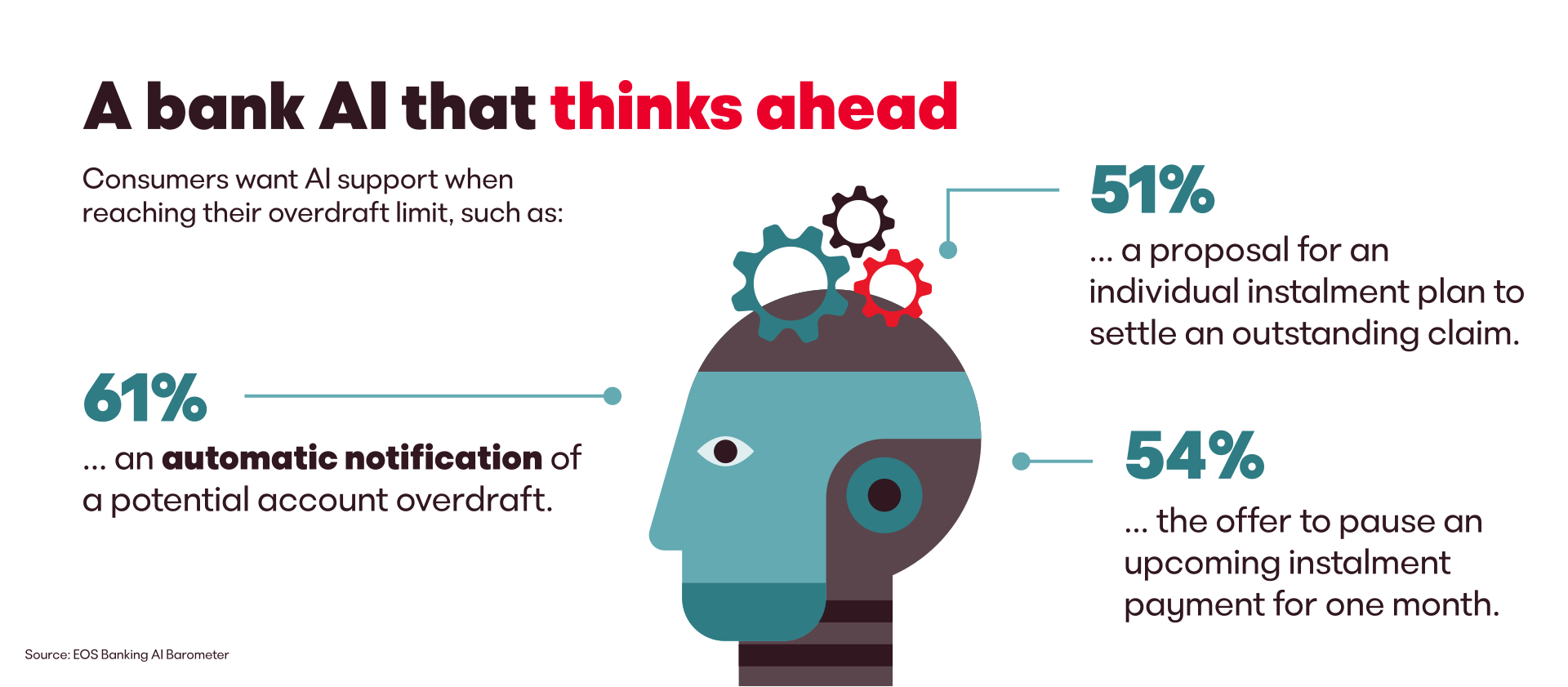
Some 61 percent of respondents would welcome AI-powered warnings when their account is at risk of being overdrawn. More than one in two people would also like AI to actively offer the option of deferring an instalment payment in the event of financial difficulties (54 percent) or suggest an individual instalment plan for settling an outstanding payment (51 percent).
This opens up new opportunities for banks. Instead of merely reacting to customer enquiries, AI systems could in future flag financial risks at an early stage and recommend suitable support services. This would make AI a financial coach for consumers. “Our study shows a clear direction in the use of AI services: customers want AI that is not only reactive but also proactive,” says Marwin Ramcke. “They are ready for smarter services; now the banks need to deliver.”
You can find more results from the EOS Banking AI Barometer here.
AI in banking: What do consumers expect and where should banks act now? Find the answers to these questions and the key findings from our survey in this short video.
For the EOS Banking AI Barometer study – How Europe really feels about AI in banking – 4,400 people in eleven European countries (Bulgaria, Croatia, France, Germany, Greece, Poland, Portugal, Romania, Slovenia, Spain and Switzerland, 400 respondents per country) were surveyed about their attitudes towards artificial intelligence in bank communications. The data was collected in July 2026, and the target group consisted of bank customers aged 18 to 65. The study was conducted online and was representative of the population.
Would you like to learn more about the latest EOS study? Please feel free to contact us.

Carina Bonde
Corporate Communications & Marketing
Phone: + 49 173 2979331
Explore more from EOS